
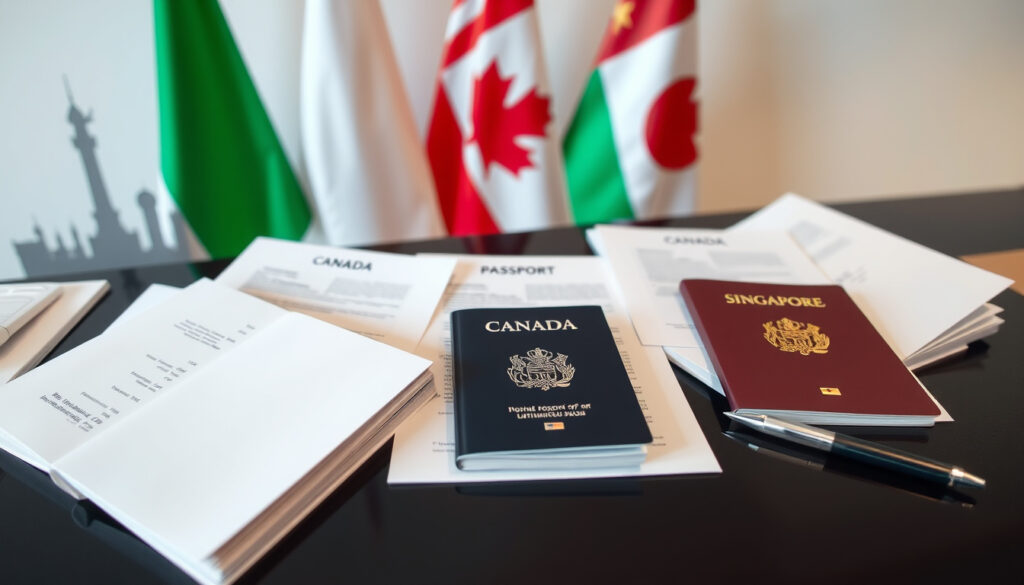
Canada’s Express Entry grants PR in six months but demands a high CRS score; Ireland requires five years of residence with no points system. This guide walks through the practical steps for both countries, so you can see exactly what’s required and whether you can handle it yourself.
Canada PR applications (2024): 471,000 ·
Express Entry processing time: 6 months ·
Ireland PR qualifying period: 5 years ·
PR application fee (Canada): $1,365 CAD ·
PR application fee (Ireland): €500 ·
Singapore PR processing time: 6-12 months
Quick snapshot
- Canada PR via Express Entry requires a CRS score (Government of Canada (IRCC))
- Ireland PR requires 5 years legal residence (Immigration Service Delivery, Ireland)
- PR does not change citizenship status (Government of Canada (IRCC))
- Exact PR processing times can vary by individual case
- Whether Ireland grants PR in 2 years for all categories remains uncertain
- Ireland long-term residence: 12-18 months typical (no official confirmation)
- Canada Express Entry: 6 months average processing (Government of Canada (IRCC))
- Check eligibility for your target country first
- Gather documents and submit online or paper application
The table below lays out the core differences between PR systems.
| Label | Value |
|---|---|
| Definition | Permanent residence allows indefinite stay but does not grant citizenship. |
| Eligibility | Varies by country – Canada uses points, Ireland requires years of residence. |
| Application method | Online portal for Canada (IRCC) and Ireland (Department of Justice). |
| Processing time | Canada 6 months, Ireland 12-18 months, Singapore 6-12 months. |
What is a PR application?
What does PR stand for?
PR stands for permanent residence — a status that lets you live and work in a country indefinitely without becoming a citizen. It’s not a visa, and it’s not citizenship. As the Government of Canada (IRCC) explains, a PR application is the formal process to obtain that status.
“PR application is the formal process to obtain that status.”
— Government of Canada (IRCC)
PR vs permanent residence
The terms are used interchangeably. A PR application is the same as applying for permanent residence. The key distinction is between PR and citizenship: PR holders can stay indefinitely but cannot vote or hold a passport from that country. Immigration Service Delivery, Ireland notes that permanent residence is not the first step for most applicants — it comes after several years of lawful stay.
Who issues PR?
Each country’s immigration authority handles PR. In Canada, it’s Immigration, Refugees and Citizenship Canada (IRCC). In Ireland, it’s the Department of Justice through Immigration Service Delivery. Singapore’s Immigration & Checkpoints Authority (ICA) manages its PR system.
“Permanent residence is not the first step for most applicants — it comes after several years of lawful stay.”
— Immigration Service Delivery, Ireland
A PR application is your ticket to indefinite stay — but it’s not citizenship. For Canada and Ireland, the process is managed by government bodies, not third parties. Anyone promising a shortcut is likely selling something you don’t need.
The implication: you need to plan for the long term – PR is a milestone, not the final destination.
Who qualifies for PR?
Canada PR eligibility
Canada’s Express Entry system is points-based. You qualify as a skilled worker, through family sponsorship, or as a provincial nominee. The Government of Canada (IRCC) states that applicants must meet a minimum CRS score to enter the pool. Provincial nomination can add a substantial CRS boost and lead to an IRCC application.
Ireland PR eligibility
Ireland’s standard route requires 5 years of legal residence. Immigration Service Delivery, Ireland specifies that applicants must demonstrate at least 60 months of legal residence under reckonable permissions. Critical Skills Employment Permit holders may apply after 2 years, but this is not the standard path.
Singapore PR eligibility
Singapore’s PR system targets employment pass holders and their families. Processing takes 6-12 months. Eligibility is assessed on economic contribution, qualifications, and family ties.
Ireland’s 2-year PR route is a myth for most applicants. Only Critical Skills Employment Permit holders qualify for that faster timeline. Everyone else needs 5 years of legal residence — no exceptions.
The pattern: Canada rewards points and speed; Ireland rewards patience and stability.
What are the requirements to apply for PR?
Required documents for PR
The Government of Canada (IRCC) provides a personalized document checklist after you complete the online form. Common items include:
- Valid passport
- Proof of funds
- Language test results (IELTS or CELPIP for Canada)
- Medical exam
- Police clearance certificates
- Relationship proof (if applicable)
- Digital photos
For Ireland, Immigration Service Delivery, Ireland requires passport copies, registration certificates, proof of address, and evidence of lawful residence.
PR application fees
Fees vary by country. Canada charges $1,365 CAD for the processing fee, right of permanent residence fee, and biometrics fee when applicable, per Government of Canada (IRCC). Ireland’s long-term residence application costs €500.
Language requirements
Canada requires language proficiency through IELTS or CELPIP. Ireland has no formal language test requirement for PR applications.
What this means: upfront investment (Canada) vs. time investment (Ireland) – choose your trade-off.
How to apply for permanent residence through Express Entry?
Steps to apply through Express Entry
The Government of Canada (IRCC) outlines a clear sequence:
- Check eligibility via CRS score
- Create an Express Entry profile
- Receive an Invitation to Apply (ITA)
- Fill out the application form online
- Upload all required documents
- Pay fees (processing, right of permanent residence, biometrics)
- Submit the application
The application cannot be submitted unless all mandatory form fields are completed and all required documents listed in the checklist are included, per Government of Canada (IRCC).
Can I do my PR application myself?
Yes. The Government of Canada (IRCC) provides the Permanent Residence Portal for online submissions. Paper applications by mail or courier are also accepted for PR card applications. You do not need a representative unless your case is complex.
What happens after you submit?
Processing takes about 6 months for Express Entry. You’ll receive biometrics instructions, background checks, and eventually a Confirmation of Permanent Residence (COPR). The Government of Canada (IRCC) notes that you can check your application status online.
DIY applicants risk missing document requirements or form fields. The IRCC system rejects incomplete applications outright. If your case is straightforward, DIY works. If you have complex work history or dependents, a representative may save time.
How do I apply for PR in Ireland?
Ireland PR in 2 years: fact or myth?
For most applicants, it’s a myth. Immigration Service Delivery, Ireland states the standard route requires 5 years of legal residence. Critical Skills Employment Permit holders may apply after 2 years, but this is a specific category, not the general rule.
Documents needed for Ireland PR
Immigration Service Delivery, Ireland requires:
- Passport copies
- Registration certificates
- Proof of address
- Evidence of lawful residence for 60 months
- Completed application form
- €500 fee
Irish PR card
Successful applicants receive a Stamp 4 permission, which allows open-ended stay. The process is paper-based, not an online points system like Canada’s Express Entry. Immigration Service Delivery, Ireland handles all applications.
The catch: Ireland rewards patience; there’s no shortcut for the majority.
Related reading: **Price of Gold Today Ireland** · **Bank of Canada Interest Rate Today**
land2air.ca, immigrationphysicianottawa.ca, youtube.com, canada.ca, youtube.com, universaladviser.com
For a more detailed look at eligibility and the application process, refer to this guide on the Canada permanent residence application.
Frequently asked questions
What is the difference between PR and citizenship?
PR allows indefinite stay but does not grant voting rights or a passport. Citizenship requires a separate application after meeting residency requirements.
Can I lose my PR status?
Yes. PR can be revoked if you commit serious crimes, fail to meet residency obligations, or provide false information on your application.
Do I need a job offer for Canada PR?
Not necessarily. Express Entry uses a points system where a job offer adds points, but many applicants qualify without one through education, experience, and language skills.
How long does it take to get PR in Ireland?
Standard route: 5 years of legal residence plus 12-18 months processing. Critical Skills permit holders: 2 years plus processing.
What is the PR card used for?
The PR card is proof of your status for travel and official purposes. You need it to re-enter Canada or Ireland after international travel.
Can I apply for PR without a representative?
Yes. Both Canada and Ireland allow DIY applications through official portals. Representatives are optional and charge fees.
For anyone weighing Canada against Ireland, the choice comes down to timeline versus complexity. Canada’s Express Entry is faster but demands higher upfront preparation — language tests, CRS scores, and a competitive points game. Ireland’s route is slower but simpler on paper, with no points system and no language test. For the skilled worker targeting Canada, the Bank of Canada Interest Rate Today and Price of Gold Today Ireland articles offer context on economic conditions in both countries. The decision is clear: invest in the points system for a faster outcome, or commit to the longer residency path for a more predictable process.
Related stories





Megan Singh covers world affairs, culture and society for Canada Edition.