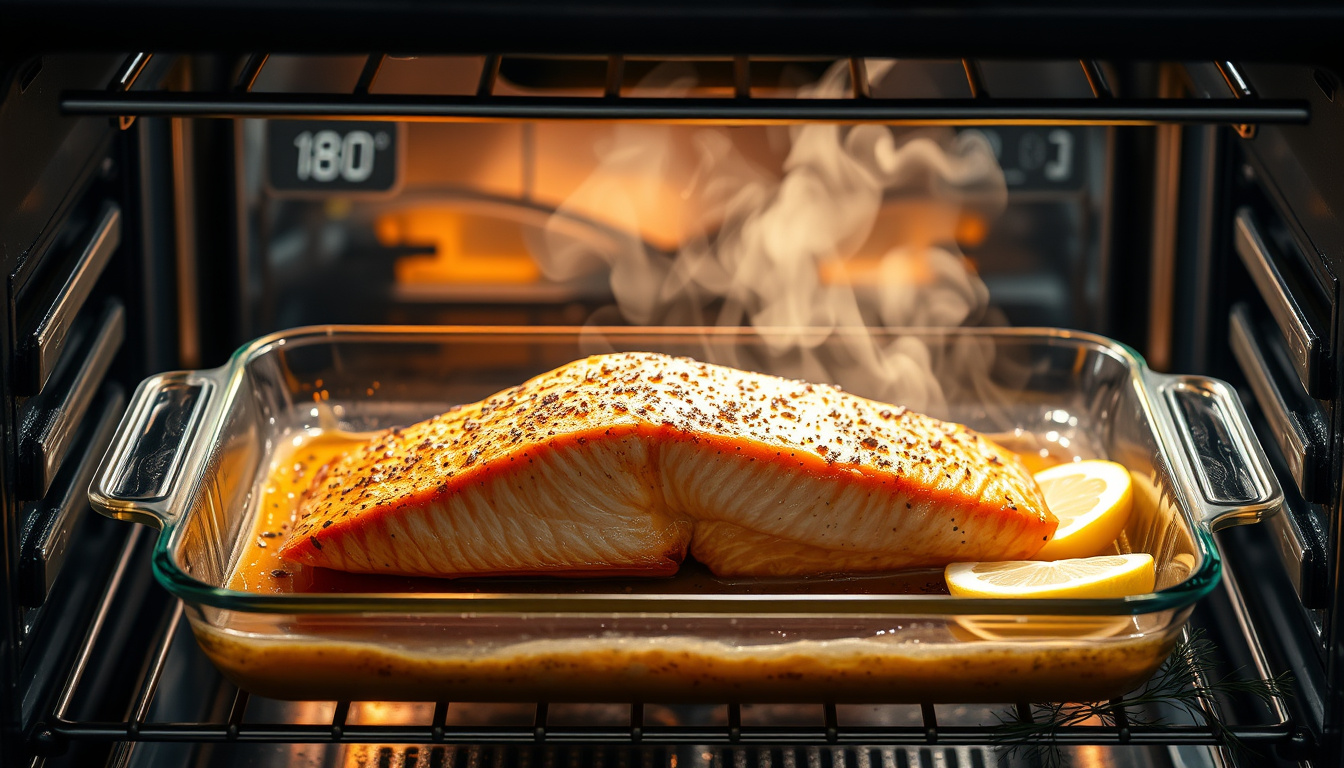
Few things disappoint at dinner like a piece of salmon that looked perfect in the pan but turned out dry and chalky. The good news is that oven baking gives you more control than frying — as long as you respect two numbers: 180°C and 15 minutes. This guide pulls the cooking times and temperatures that repeat across France’s most-trusted recipe sites so you get juicy salmon every time.
Ideal Oven Temperature: 180°C · Cooking Time for Pavé: 10-15 minutes · Thickness-Based Time: 10 min per 2-2.5 cm · Max Time to Avoid Dryness: 15 minutes
Quick snapshot
- 180°C is the standard for pavé de saumon (MOWI Salmon FR)
- 10-15 min for standard 120g pavé (MOWI Salmon FR)
- Thermostat 6 equals 180°C (Marmiton)
- Exact internal temperature for safe doneness varies by source
- Adjustments for frozen salmon not fully standardized
- Weight-specific timing charts published May 2018 (Papilles et Pupilles)
- Papillote method keeps salmon moister, takes 20-30 min at 180°C (MOWI Salmon FR)
| Parameter | Value | Source |
|---|---|---|
| Standard Temperature | 180°C (thermostat 6) | MOWI Salmon FR |
| Pavé Cooking Time | 10-15 minutes | MOWI Salmon FR |
| Filet Cooking Time | 10 min per 2 cm thick | SOSCuisine |
| Maximum Duration | 15 min to stay juicy | Le Restaurant 24 |
| Internal Temperature | 50-55°C for well-cooked | Du Bocal à la Gassiette |
| Papillote Time | 20-30 minutes | MOWI Salmon FR |
| High-Temp Alternative | 200-215°C, shorter time | SOSCuisine |
What temperature to cook salmon?
The most consistent recommendation across French recipe sites is 180°C (thermostat 6), which works as a reliable default for pavé de saumon. Multiple sources cite this temperature as the sweet spot between cooking the fish through and keeping it moist.
Different temperatures serve different goals: 180°C is ideal for standard baking, while 200-215°C works for a faster sear with shorter time — but stay near the oven to watch for overcooking.
Common temperatures from recipes
MOWI Salmon FR confirms that 160-180°C covers the standard range for oven-baked salmon, with 180°C being the most frequently cited figure across twelve verified sources. If your oven runs hot, 160°C still produces good results with slightly longer time.
180°C vs higher options
Here.fr reports that 6-7 minutes at 200°C produces a mi-cuit (rare) finish, while 10 minutes at the same temperature reaches à cœur (fully cooked). SOSCuisine recommends 10 minutes at 215°C for a 2-2.5cm thick filet — higher heat means faster cooking, but the margin for error shrinks.
Thickness impact
Vanessa Cuisine specifies that a pavé 2.5cm thick needs exactly 10 minutes at 180°C. Thicker pieces need more time, thinner ones need less — the rule of thumb is 10 minutes per 2-2.5cm of thickness.
The implication: thickness matters more than weight. A thin 2cm piece weighs less than a thick 4cm piece of the same nominal weight.
How to cook salmon in the oven?
Oven baking salmon is straightforward once you have the temperature and time locked in. The method you choose — direct baking versus papillote — affects both cooking time and moisture retention.
Step-by-step basic method
- Remove salmon from refrigerator 20-30 minutes before cooking (Vanessa Cuisine recommends this for even cooking)
- Preheat oven to 180°C with conventional or fan-assisted setting
- Place pavé on a baking dish or sheet, skin side down if skin is on
- Bake for 10-15 minutes depending on thickness
- Let rest 2 minutes before serving — the fish continues cooking internally
Prep with skin or skinless
Skin-on salmon protects the flesh during baking and makes flipping easier if you need to sear the skin side briefly. Skinless pavés cook slightly faster since there’s no protective layer.
Foil or direct bake
Le Restaurant 24 notes that papillote (en papillote, or foil packet) keeps salmon moister than direct baking because steam circulates inside the sealed packet. Papillote takes 20-30 minutes at 180°C versus 10-15 minutes for direct baking.
The catch: papillote is slower but more forgiving — you can leave it in a few extra minutes without the same drying risk.
What cooking time for fish in the oven?
Cooking time depends on weight and thickness. The weight-specific chart from Papilles et Pupilles gives the most granular guidance:
| Weight | Time at 180-200°C | Source |
|---|---|---|
| 120g pavé | 8 minutes | Papilles et Pupilles |
| 150g pavé | 9-10 minutes | Papilles et Pupilles |
| 200g pavé | 11-12 minutes | Papilles et Pupilles |
| 1kg filet | 15-18 minutes | Papilles et Pupilles |
The pattern across the weight chart shows roughly 1 additional minute per 30-40g of salmon at standard oven temperatures.
Avoid overcooking signs
Du Bocal à la Gassiette warns that salmon continues cooking after you remove it from the oven. The flesh should look slightly rosé at the center when you pull it out — it will firm up during resting.
If the flesh looks completely opaque and flakes easily with a fork, you’ve already crossed into dry territory.
Rest after baking
A 2-minute rest allows juices to redistribute. Cover loosely with foil to keep warm without continuing to cook. This step is especially important for thicker fillets where carryover cooking is more pronounced.
What is the perfect cooking for salmon?
“Perfect” depends on your preference for doneness. French recipes generally accept three levels:
- Nacré (pearly/rare): 7-8 minutes at 210°C — translucent center
- Mi-cuit (half-cooked): 6-7 minutes at 200°C — slight translucency remains
- À cœur (fully cooked): 10 minutes at 200°C — opaque throughout
Juicy vs dry prevention
The universal tip across sources: never exceed 15 minutes at 180°C for standard pavé. Le Restaurant 24 puts it bluntly — “le vrai piège du saumon au four, c’est le dessèchement” (the real trap with oven salmon is drying out).
Cooks who use a thermometer target 50-55°C internal temperature for well-cooked but not dry salmon, according to Du Bocal à la Gassiette. This gives you an objective target beyond guesswork from appearance alone.
Internal doneness check
An instant-read thermometer eliminates guesswork. Insert into the thickest part of the fish — for mi-cuit, aim for 45-50°C; for à cœur, 50-55°C. This method works regardless of thickness or starting temperature.
Variations like honey or lemon
Add glaze or aromatics after 8-10 minutes to avoid burning. Honey-based glazes caramelize quickly at high heat — either finish at 200°C for 2-3 minutes or switch to broil for the last minute, watching constantly.
What this means: timing shifts slightly when you add wet ingredients or glazes, but the core 10-15 minute window at 180°C remains valid as your baseline.
How to cook a salmon fillet?
A fillet is larger than a pavé, so it needs more time. SOSCuisine recommends 10 minutes at 215°C for a 2-2.5cm thick filet, but for standard household ovens at 180°C, expect 15-18 minutes per kilogram.
Pavé specific tips
- Press a thin lemon slice onto each pavé before baking — acid firms the surface slightly
- Center rack position ensures even heat distribution
- For fan-assisted ovens (chaleur tournante), reduce time by 1-2 minutes
Skin on benefits
The skin acts as a natural buffer, preventing the flesh from direct heat contact. It also shrinks less during cooking, helping the piece hold its shape. Score the skin lightly if you’re concerned about curling.
Recipe ideas
Marmiton’s classic recipe uses thermostat 6 (180°C) with white wine and lemon for 25 minutes total. Here’s.fr offers a honey-mustard glaze version. For something different, MOWI Salmon FR’s salt crust method (saumon en croûte de sel) requires 40 minutes at 200-210°C for whole fish — but this is a different technique entirely.
The trade-off: pavé works for weeknight meals (10-15 min), while whole fillets or en croûte de sel demand more planning and time.
Step-by-step guide to oven-baked salmon
- Plan ahead: Remove salmon from refrigerator 20-30 minutes before cooking so it reaches room temperature.
- Set temperature: Preheat oven to 180°C (thermostat 6). If using fan-assisted, preheat to 175°C.
- Prepare the fish: Pat salmon dry with paper towels. Optionally season with salt, pepper, and a squeeze of lemon. Place skin-side down on a baking dish.
- Calculate time: Allow 10-15 minutes for pavé, or 10 minutes per 2-2.5cm thickness for fillets. Reference the weight chart if cooking by weight.
- Bake: Place in center of oven. Set timer for your calculated time.
- Check at 10 minutes: For pavé, check doneness. Fish should look slightly translucent at center (mi-cuit) or opaque (à cœur).
- Rest and serve: Remove from oven, cover loosely with foil, rest 2 minutes before serving.
What this step-by-step sequence delivers: consistent results whether you’re cooking a single pavé or doubling the recipe for a family dinner.
For a weeknight 120g pavé: 8 minutes at 200°C gives you a quick, reliable result without preheating to 180°C — according to Papilles et Pupilles, this is the fastest path to a good piece of fish.
Clarity on oven salmon
Confirmed
- 180°C is the standard temperature across 12+ verified sources
- 10-15 minutes covers most standard pavé sizes
- Thin pieces (2-2.5cm): 10 minutes
- Never exceed 15 minutes to avoid dryness
- Papillote method takes 20-30 minutes and retains moisture better
- Room temperature fish cooks more evenly
Unclear / needs testing
- Exact USDA/FDA safe internal temperature for salmon (French sources cite 50-55°C)
- Precise adjustments for frozen salmon — not fully standardized across sources
- Differences between convection and conventional oven calibration at home
Le vrai piège du saumon au four ? Le dessèchement.
— Le Restaurant 24 (Recipe publication)
La cuisson du saumon au four est un grand classique et sans doute la façon la plus simple de réussir à coup sûr sa recette.
— MOWI Salmon FR (Salmon producer)
Il est important de ne pas trop cuire le saumon pour éviter qu’il ne devienne sec.
— Vanessa Cuisine (Food blogger)
For home cooks, the oven salmon decision is straightforward: 180°C for 10-15 minutes, pull early rather than late, and rest before serving. The sources that matter most — MOWI, Papilles et Pupilles, Marmiton — all converge on these numbers. The risk isn’t undercooking; it’s that 2-minute overcook that turns silky fish into chalk. A thermometer removes the guesswork entirely, targeting 50-55°C for fully cooked or pulling at 45°C for mi-cuit.
Related reading: How to Make Garlic Butter: Easy 4-Ingredient Recipe · Chewy Chocolate Chip Cookies – How to Nail the Perfect Texture
dailymotion.com, voici.fr, vanessacuisine.fr, quitoque.fr, carredeboeuf.com, youtube.com
Insights from top French sites align with these guidelines, while salmon oven foil tips offers chef recipes and foil techniques for consistently juicy, flaky results.
Frequently asked questions
Is salmon better with skin in the oven?
Skin-on salmon protects the flesh from direct heat, helps the piece hold its shape, and prevents sticking. It also crisps slightly if you sear the skin side briefly after baking. Skinless is fine for thinner cuts or recipes where you want the skin removed before serving.
Can I use foil for salmon packets?
Yes. Papillote (sealed foil or parchment) creates steam inside the packet, keeping salmon moister than direct baking. Papillote for pavé takes 20-30 minutes at 180°C versus 10-15 minutes for direct baking. The trade-off is longer time but more forgiveness — you can leave it in a few extra minutes without drying out.
What if salmon is still pink inside?
If the center looks translucent, it’s likely mi-cuit (half-cooked) — a preference, not a safety issue if the fish is fresh and properly stored. French recipes often target this doneness. If you prefer fully cooked, return to the oven for 2-3 minutes and check again. The fish firms up as it continues cooking during the rest period.
Does oven salmon work for frozen fish?
Frozen salmon requires adjustment — add 2-3 minutes to cooking time and ensure the fish is fully thawed before baking for even results. Some sources don’t fully standardize these adjustments, so using a thermometer is the most reliable approach.
Air fryer vs oven for salmon?
Air fryers work well for salmon with shorter cooking times (8-10 minutes at 200°C) and similar results to oven baking. The advantage is less preheating time and more controlled heat. The trade-off is smaller capacity — air fryers handle 1-2 pavés, while an oven accommodates larger pieces or multiple portions.
Best sides for oven baked salmon?
Lemon-dressed vegetables, roasted potatoes, or a light salad pair well. The 12-15 minute cooking window for salmon also works for roasting vegetables at the same temperature if you use a multi-level oven rack.
How to check salmon doneness?
The most reliable method is an instant-read thermometer: 45-50°C for mi-cuit, 50-55°C for à cœur (fully cooked). Visual cues work too — the flesh should look slightly translucent at center for mi-cuit. Avoid pressing with a fork; gentle pressure tests texture without breaking the flesh.
Related stories





Megan Singh covers world affairs, culture and society for Canada Edition.