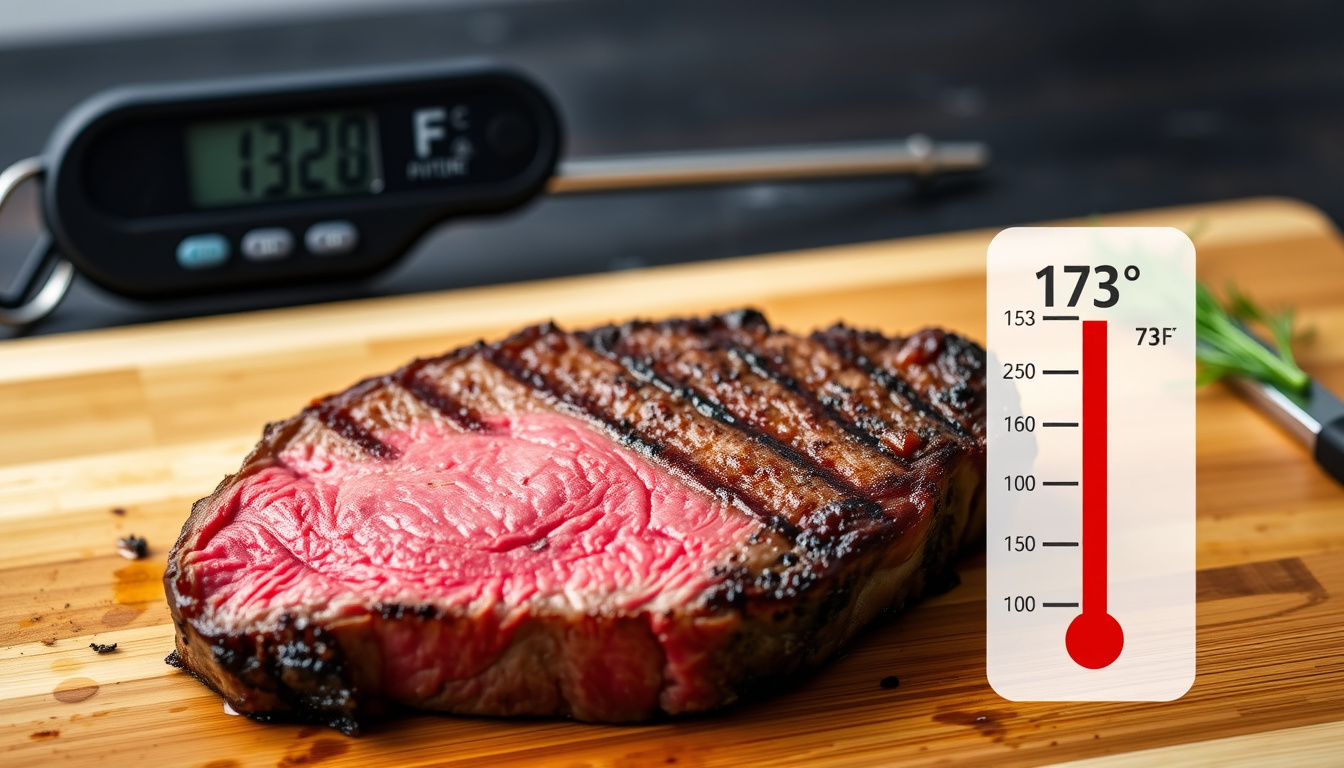
If you’ve ever pulled a steak off the grill only to find it more done than expected, you’ve learned the hard way that carryover cooking is real. A thermometer takes the guesswork out of the equation, but knowing when to pull versus when it’s truly finished makes all the difference. This guide walks through verified steak temperatures, the pull-temp method, and the timing rules that professional kitchens use to hit medium rare every time.
Medium Rare Temp (Final): 130-135°F / 54-57°C · Remove from Heat: 125°F / 52°C · Medium Temp: 135-144°F / 57-62°C · Rare Temp: 120°F / 49°C · USDA Safe Minimum: 145°F / 63°C
Quick snapshot
- Medium rare consistently lands at 130-135°F across major steakhouse and beef producer guides (Clover Meadows Beef)
- Carryover cooking adds 3-5°F on thinner cuts, 5-10°F on larger steaks (Clover Meadows Beef)
- Exact safety threshold for vulnerable populations below USDA’s 145°F minimum remains debated among food safety authorities
- Lack of peer-reviewed studies quantifying carryover rise under controlled conditions
- USDA established 145°F minimum for whole cuts in 2011; steakhouse culture embraced medium rare decades earlier
- Thermometer technology improvements have shifted home cooks toward more precise doneness targeting since the 2010s
- Sous vide and precision cooking methods continue pushing adoption of exact temperature targeting among home cooks
- Ongoing tension between food safety authorities and culinary tradition around lower doneness preferences
| Doneness Level | Final Internal Temp | Texture & Appearance |
|---|---|---|
| Rare | 120-129°F (48-54°C) | Cool, bright red center; soft texture |
| Medium Rare | 130-135°F (54-57°C) | Warm red center; beginning to firm; red juices |
| Medium | 135-144°F (57-62°C) | Warm pink center; outer portions brown; firm texture |
| Medium Well | 145-154°F (63-68°C) | Slightly pink center; completely firm; brown juices |
| Well Done | 155-164°F (68-73°C) | No pink or red; firm throughout |
The table above maps doneness level to final internal temperature, showing where each stage sits relative to USDA’s 145°F minimum for whole cuts. The key variable is pull temperature: remove 5°F before your target and let carryover finish the job.
What temperature is medium rare in C?
Medium rare translates to 54-57°C on a Celsius scale, but the practical answer involves two distinct measurements. Professional sources like ThermoWorks and Ruth’s Chris Steakhouse distinguish between the temperature when you pull the steak from heat and the final serving temperature after resting.
Fahrenheit vs Celsius conversion
The standard conversion puts medium rare between 130-135°F or 54-57°C. A one-inch ribeye cooked to medium rare typically finishes around 57°C at the thickest part of the center. Thinner cuts may read slightly lower, which is where the pull-temp method becomes essential.
Is medium rare 135 or 145?
Medium rare is 130-135°F final, not 145°F. The USDA classifies 145°F as medium, which means the agency’s official “medium” sits well above the medium rare target. Confusion arises because 145°F is also the agency’s recommended safe minimum for whole cuts—creating overlap between safety and doneness terminology that chefs and food safety authorities define differently.
Remove from heat vs final temp
Account for carryover cooking by pulling 5°F (about 3°C) before your target. For a 130°F medium rare finish, remove the steak at 125°F. The residual heat continues cooking the interior for 3-5 minutes during resting, delivering the desired result without overshooting. Omaha Steaks notes that color alone is not a foolproof indicator—thermometer readings eliminate the guesswork.
Steak Temperature Guide to Rare, Medium, & Well-Done Steaks
Five doneness levels define the steak experience. Each level corresponds to a specific internal temperature range, texture profile, and flavor outcome. Clover Meadows Beef provides the most comprehensive cross-referenced chart across the industry.
Rare temps
Rare steak sits at 120-129°F (49-54°C). The center stays cool and bright red with a soft, yielding texture. This doneness level suits leaner cuts without heavy marbling—the lower temperature preserves moisture in cuts that lack fat reserves to render. Omaha Steaks notes that rare works particularly well for top sirloin or filet mignon where less fat needs melting.
Medium temps
Medium steak lands at 135-144°F (57-62°C), aligning with USDA’s official standard for whole cuts. The center turns warm pink while the outer portions brown completely. The texture becomes fully firm throughout. Sullivan’s Steakhouse notes that medium strikes a balance for cautious eaters who want more assurance than rare provides while retaining considerable moisture.
Well done temps
Well done requires 155-164°F (68-73°C). At this temperature, the steak loses all pink coloration and most of its juices. Omaha Steaks cautions that well-done cooking drives off fat and moisture, resulting in a drier, tougher texture. Most steakhouses treat well-done as a last resort rather than an intentional choice.
Internal Temperature for Steaks from Rare to Well Done
A calibrated meat thermometer remains the most reliable instrument for targeting these ranges. Insert the probe through the side of the thickest part, avoiding bone or fat deposits that can give false readings. Omaha Steaks recommends this lateral insertion method over top-down poking for accuracy.
What is the 3-3-3 rule for steaks?
The 3-3-3 rule breaks pan-searing a steak into three equal phases of three minutes each. Sear the first side for 3 minutes, flip and sear the second side for 3 minutes, then rest covered for 3 minutes before cutting. This method works best on 1-inch-thick cuts cooked in a ripping-hot skillet.
Rule breakdown
The logic behind the rule is straightforward: 3 minutes of high heat develops a proper Maillard crust on each side. The resting period allows carryover cooking to finish the interior while the crust remains intact. Three minutes per side typically yields medium rare on thinner steaks at high heat.
Application to thickness
Adjust the timing proportionally for thicker cuts. A 1.5-inch ribeye needs 4-5 minutes per side and benefits from the reverse-sear method instead. Start low and slow in the oven to bring the interior to temperature, then sear hard at the end. The 3-3-3-3 variant adds a fourth 3-minute phase for thicker steaks requiring more oven time.
The 3-3-3 rule assumes a standard 1-inch thickness and a screaming-hot pan. Thinner cuts will overcook; thicker cuts will undercook. Gauge by internal temperature, not by clock.
What is the 4 minute rule for steak?
The 4-minute rule provides a quick-reference framework for pan-cooking a 1-inch steak to specific doneness levels. Each side gets 2 minutes for rare, scaling up proportionally for more done steaks.
For 1 inch thick
Two minutes per side reliably produces rare on standard 1-inch cuts in a heavy skillet over high heat. Four minutes total, plus 3 minutes rest, delivers a consistent result without a thermometer. Medium requires roughly 3 minutes per side; medium well needs 4 minutes per side.
Rare timing
Rare cooking at 2 minutes per side works because the exterior chars quickly while the interior stays cool. The resting period after removing from heat continues the cooking process. Without a thermometer, timing provides the most accessible proxy for doneness.
For thicker steaks over 1.5 inches, the 4-minute rule breaks down. A thick-cut porterhouse needs the reverse sear method: low oven first, hard sear second. Jumping straight to the pan produces an over-charred exterior with a raw center.
Can you eat 120 degree steak?
A 120°F steak qualifies as rare doneness, which falls below the USDA’s recommended minimum of 145°F for whole cuts. The safety picture depends on context: for healthy adults, the risk is generally considered acceptable by culinary standards, though food safety authorities recommend the higher temperature.
Safety at rare temps
USDA’s Certified Angus Beef guidelines state that steaks and roasts should reach 145°F as a minimum. This threshold was established based on pathogen destruction data. For healthy individuals eating high-quality beef from reputable sources, many chefs and steakhouse professionals prepare steaks below this threshold regularly.
Carryover to medium rare
The practical implication: pulling at 120°F and resting for 3-5 minutes typically yields 125-130°F—a medium rare finish. If your target is medium rare, remove the steak from heat at 125°F rather than waiting for the interior to reach 130°F on the heat source. This prevents overcooking during resting.
How to cook a perfect medium rare steak (step by step)
Follow this sequence to hit 130-135°F consistently, whether pan-searing or grilling. The critical variable is the thermometer reading at pull, not an arbitrary cook time.
- Bring steaks to room temperature. Let them rest on the counter for 20-30 minutes before cooking. Cold steaks cook unevenly.
- Pat dry and season generously. Salt draws moisture to the surface, which then evaporates and aids browning. Pepper, garlic, or steak seasoning complement the sear.
- Heat your cooking surface. Cast iron or stainless steel at medium-high heat, preheated until smoking. Grill at high heat across the grate.
- Insert thermometer into the side. Push the probe horizontally through the thickest part, avoiding bone and fat. Note the starting temperature.
- Cook, monitoring temperature. Flip once the sear develops, usually 2-4 minutes per side depending on thickness.
- Pull at 125°F. Remove from heat when the thermometer reads 125°F. The interior continues rising during resting.
- Rest for 3-5 minutes. Tent loosely with foil. The carryover adds 3-5°F, landing you at 130°F—a perfect medium rare.
Resting longer on thicker cuts adds more carryover—up to 10°F on 2-inch ribeyes. Adjust your pull temperature downward by 5°F for every additional half-inch of thickness beyond 1 inch.
Why medium rare is the most popular doneness
Ruth’s Chris Steakhouse reports that medium rare ranks as the most commonly ordered doneness level at steakhouses. Several factors converge to explain this preference.
At 130-135°F, the collagen in connective tissue has begun dissolving without fully breaking down, yielding a tender texture without the chewiness of rare. Simultaneously, the fat marbling in prime and choice cuts renders enough to impart rich, buttery flavors. Omaha Steaks explains that medium rare sits in the sweet spot where tenderness and flavor maximization overlap.
Thick cuts like ribeye and porterhouse particularly benefit from medium rare. The heavy marbling in these cuts releases fat at this temperature range, creating the signature juicy, rich experience that premium steakhouses promise. Leaner cuts like flank or sirloin may suit rarer temperatures better, since they lack the marbling that makes medium rare sing on fattier cuts.
“Be sure to check with a thermometer, as color alone is not a foolproof indicator of steak doneness.”
— Certified Angus Beef (industry organization)
Food safety: USDA standards vs. culinary tradition
USDA’s recommendation of 145°F as a minimum reflects food safety research. Pathogens like E. coli and Salmonella are destroyed at this temperature when maintained for the appropriate time. The agency also mandates a 3-minute rest period after cooking to allow for continued pathogen destruction.
Culinary professionals frequently cook to lower temperatures for quality reasons. Sullivan’s Steakhouse notes that many steak lovers and chefs cook tender cuts below USDA minimums to optimize flavor and texture. High-quality, aged beef from reputable suppliers reduces pathogen risk, though it never eliminates it entirely.
“The USDA recommends steaks and roasts be cooked to 145° F (medium) and then rested for at least 3 minutes.”
— Certified Angus Beef (industry organization)
For ground beef, the standard differs. Certified Angus Beef specifies a minimum of 160°F for ground beef because mechanical processing can distribute surface pathogens throughout the meat. Steaks cut from whole muscle, by contrast, have negligible interior contamination risk.
Upsides
- Medium rare delivers optimal fat rendering and moisture retention simultaneously
- The pull-temp method produces consistent results across different cut thicknesses
- Carryover science eliminates overcooking anxiety once you know the 3-5°F adjustment
Downsides
- USDA safety standard sits at 145°F, above most medium rare targets—personal risk assessment required
- Thinner cuts demand tighter timing; less room for error than thick, slow-cooked preparations
- Thermometer required for precision—guesswork frequently misses the target by 5-10°F
Related reading: Baking salmon oven temperature guide · Garlic butter recipe for steak
Frequently asked questions
What is medium rare steak temp F?
Medium rare steak measures 130-135°F when fully rested. Pull from heat at 125°F to account for carryover cooking during the 3-5 minute rest period.
Is 60C medium rare?
No. Sixty degrees Celsius equals 140°F, which falls in the medium well range. Medium rare requires 54-57°C (130-135°F) after resting.
Medium rare steak temp time?
On a 1-inch steak in a screaming-hot pan, cook 2-3 minutes per side for medium rare, then rest 3-5 minutes. Thicker cuts require longer; thinner cuts require less. Internal temperature reading, not clock time, determines doneness.
Medium well steak temp?
Medium well steak measures 145-154°F. Pull at 140°F and rest 3-5 minutes to land in this range. The texture becomes fully firm with minimal pink.
Medium-rare steak temperature sous vide?
Set your sous vide bath to 130°F for medium rare. Because sous vide cooks evenly throughout, there’s no carryover cooking—remove and serve immediately or sear briefly for crust if desired.
Medium rare steak temp on grill?
Grill at high heat (450-500°F) for 4-6 minutes per side on a 1-inch steak. Monitor with a probe thermometer, pulling at 125°F for medium rare after resting. Thick cuts benefit from a two-zone setup: sear over direct heat, finish over indirect.
How long to cook a steak?
A 1-inch steak needs roughly 4-6 minutes total on high heat for medium rare. Thicker 1.5-inch cuts need 8-12 minutes. The answer depends entirely on thickness, heat intensity, and your target doneness—use a thermometer, not a timer.
What is the 3-3-3-3 rule for steaks?
The 3-3-3-3 rule adds a fourth phase for thicker steaks: 3 minutes sear, 3 minutes rest, 3 minutes reverse sear (oven), then 3 minutes final sear. This sequence works better for cuts over 1.5 inches where the 3-3-3 method produces uneven results.
For home cooks, the decision is straightforward: invest in a reliable instant-read thermometer and learn your pull temperature. For a 130°F medium rare, pull at 125°F, rest 3-5 minutes, and serve. Steakhouses have operated on this principle for decades—the science backs the method.