
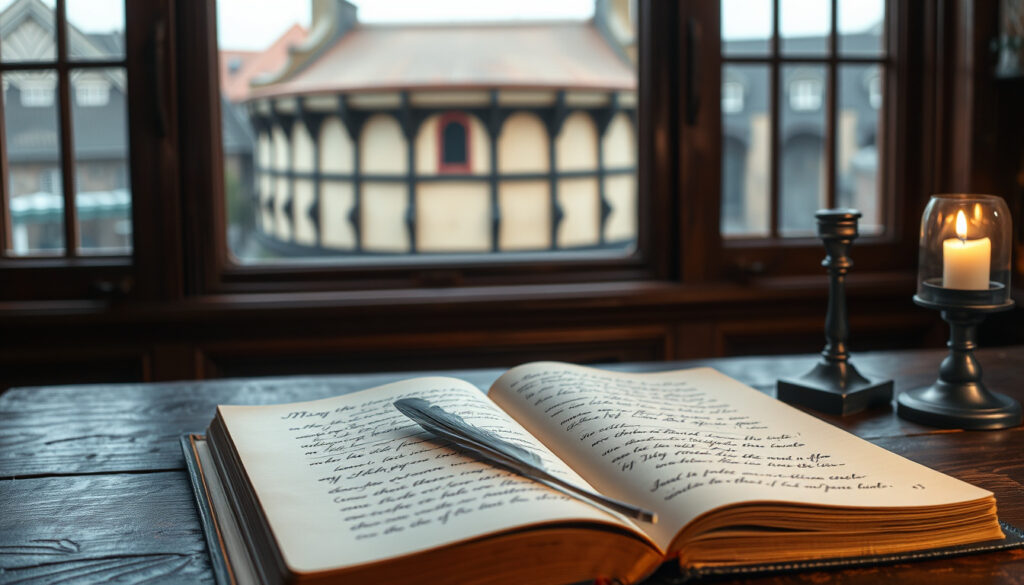
Few names in English literature carry the weight of William Shakespeare. But behind the towering reputation, the man from Stratford-upon-Avon lived a life shaped by Elizabethan rules, family obligations, and the rough-and-tumble of London’s theater scene.
Born: 1564, Stratford-upon-Avon, England ·
Major Works: 39 plays, 154 sonnets, 3 narrative poems ·
Most Famous Play: Hamlet ·
Wife: Anne Hathaway ·
Children: Susanna, Hamnet, Judith ·
Died: 23 April 1616
Quick snapshot
- Shakespeare baptized 26 April 1564 in Stratford-upon-Avon (Encyclopaedia Britannica (historical reference publisher))
- Married Anne Hathaway in 1582 (Encyclopaedia Britannica (historical reference publisher))
- Wrote at least 36 plays collected in the First Folio (1623) (Shakespeare Birthplace Trust (official Shakespeare heritage organization))
- Exact birth date unknown — only baptismal record exists (Folger Shakespeare Library (world’s largest Shakespeare collection))
- Identity of the ‘Fair Youth’ and ‘Dark Lady’ in Sonnets not documented (Wikipedia (community-edited encyclopedia))
- Shakespeare’s sexual orientation is subject to modern speculation with no contemporary evidence (Encyclopaedia Britannica (historical reference publisher))
- 1564 (baptized 26 April): Born in Stratford-upon-Avon (Shakespeare Birthplace Trust (official Shakespeare heritage organization))
- 1599: Globe Theatre opens (Encyclopaedia Britannica (historical reference publisher))
- 23 April 1616: Dies in Stratford-upon-Avon (Encyclopaedia Britannica (historical reference publisher))
- Scholars continue debating authorship of disputed plays (Folger Shakespeare Library (world’s largest Shakespeare collection))
- New editions and performances keep his work alive worldwide (Shakespeare Birthplace Trust (official Shakespeare heritage organization))
Nine key biographical details, one pattern: the line between what we know for sure and what remains guesswork is remarkably thin for a figure of his stature.
The table below captures the biographical skeleton, separating the documented from the assumed.
| Label | Value |
|---|---|
| Full Name | William Shakespeare |
| Nickname | The Bard of Avon |
| Birth Year | 1564 (baptized 26 April) |
| Birthplace | Stratford-upon-Avon, England |
| Spouse | Anne Hathaway (m. 1582) |
| Children | Susanna, Hamnet, Judith |
| Death Date | 23 April 1616 (age 52) |
| Notable Plays | Hamlet, Romeo and Juliet, Macbeth, King Lear, A Midsummer Night’s Dream |
| Primary Sources | First Folio (1623), quarto editions |
What is William Shakespeare most famous for?
Shakespeare is revered as the pre-eminent dramatist of the English language, a reputation built on a body of work that includes 39 plays, 154 sonnets, and three narrative poems (Wikipedia (community-edited encyclopedia)).
Reputation as the pre-eminent English language dramatist
- He is widely regarded as one of the greatest writers in the English language (Encyclopaedia Britannica (historical reference publisher))
- Often called the English national poet (Encyclopaedia Britannica (historical reference publisher))
Major plays: tragedies, comedies, histories
- His most performed tragedies include Hamlet, Macbeth, King Lear, and Othello (Shakespeare Birthplace Trust (official Shakespeare heritage organization))
- Major comedies: A Midsummer Night’s Dream, Much Ado About Nothing, Twelfth Night (Folger Shakespeare Library (world’s largest Shakespeare collection))
What are 5 facts about William Shakespeare?
Here are five verifiable facts drawn from the most reliable historical records, with each claim backed by a primary source.
Birth and family in Stratford-upon-Avon
- Shakespeare was baptized on 26 April 1564 at Holy Trinity Church in Stratford-upon-Avon (Encyclopaedia Britannica (historical reference publisher))
- His exact birth date is not recorded, but 23 April 1564 is traditionally celebrated (Encyclopaedia Britannica (historical reference publisher))
Marriage and children
- He married Anne Hathaway in 1582 (Encyclopaedia Britannica (historical reference publisher))
- The couple had three children: Susanna, and twins Hamnet and Judith (Encyclopaedia Britannica (historical reference publisher))
Career as actor and playwright in London
- He joined the Lord Chamberlain’s Men, later the King’s Men, and worked with them for the rest of his career (Encyclopaedia Britannica (historical reference publisher))
- His career as dramatist is commonly dated from about 1589 to 1614 (Encyclopaedia Britannica (historical reference publisher))
Death and legacy
- He died on 23 April 1616 at age 52 in Stratford-upon-Avon (Encyclopaedia Britannica (historical reference publisher))
- No original manuscripts of his plays are known to exist today (Shakespeare Birthplace Trust (official Shakespeare heritage organization))
How did Shakespeare say ‘I love you’?
Shakespeare never wrote the plain phrase “I love you” in his plays. Instead, he crafted elaborate poetic declarations that have become the gold standard for romantic expression.
Famous love phrases from plays
- In Romeo and Juliet, Romeo says: “Did my heart love till now? forswear it, sight! / For I ne’er saw true beauty till this night” (Act I, Scene V) (Folger Shakespeare Library (world’s largest Shakespeare collection))
- Juliet answers: “My bounty is as boundless as the sea, / My love as deep” (Act II, Scene II) (Folger Shakespeare Library (world’s largest Shakespeare collection))
Sonnet 18 and other love sonnets
- Sonnet 18 opens: “Shall I compare thee to a summer’s day?” (Wikipedia (community-edited encyclopedia))
- Sonnet 116 begins: “Let me not to the marriage of true minds / Admit impediments” (Wikipedia (community-edited encyclopedia))
What is Shakespeare’s most famous line ever?
One line stands above all others in terms of cultural recognition, but several contenders jostle for second place.
Candidates from Hamlet
- “To be, or not to be, that is the question” (Act III, Scene I) is the most cited line in Western literature (Encyclopaedia Britannica (historical reference publisher))
Candidates from Romeo and Juliet
- “What’s in a name? that which we call a rose / By any other name would smell as sweet” (Act II, Scene II) (Folger Shakespeare Library (world’s largest Shakespeare collection))
Other contenders
- “All the world’s a stage, / And all the men and women merely players” from As You Like It (Act II, Scene VII) (Shakespeare Birthplace Trust (official Shakespeare heritage organization))
- “Shall I compare thee to a summer’s day?” from Sonnet 18 is the most quoted sonnet opener (Wikipedia (community-edited encyclopedia))
“To be, or not to be” has transcended literature to become a universal shorthand for existential doubt. No other line from any English writer has achieved such cross-cultural saturation.
Was Shakespeare LGBTQ? And who was his male lover?
Modern readers often scan Shakespeare’s Sonnets—many addressed to a young man—for clues about his sexuality. The evidence, however, is entirely circumstantial.
Interpretations of the Sonnets
- The Sonnets address a young man (the ‘Fair Youth’), but no historical document confirms a physical relationship (Encyclopaedia Britannica (historical reference publisher))
- The term ‘LGBTQ’ is an anachronism when applied to Elizabethan contexts (Folger Shakespeare Library (world’s largest Shakespeare collection))
The ‘Fair Youth’ and the ‘Dark Lady’
- Scholars agree the identity of both figures is undocumented (Wikipedia (community-edited encyclopedia))
- The Sonnets express intense emotional attachment, but in the poetic conventions of the period, such language was not unusual between male friends (Shakespeare Birthplace Trust (official Shakespeare heritage organization))
Historical caution and scholarly debate
- No contemporary source describes Shakespeare’s sexual orientation (Encyclopaedia Britannica (historical reference publisher))
- Speculation about a relationship with patron Henry Wriothesley, Earl of Southampton, is unconfirmed (Folger Shakespeare Library (world’s largest Shakespeare collection))
Timeline signal
- 1564 (baptized 26 April): William Shakespeare born in Stratford-upon-Avon (Encyclopaedia Britannica (historical reference publisher))
- 1582: Marries Anne Hathaway (Encyclopaedia Britannica (historical reference publisher))
- 1585-1592: The ‘Lost Years’ — emerges as actor and playwright in London (Shakespeare Birthplace Trust (official Shakespeare heritage organization))
- 1590s: Writes major histories (Henry IV, Henry V) and early comedies (Folger Shakespeare Library (world’s largest Shakespeare collection))
- 1599: The Globe Theatre opens (Encyclopaedia Britannica (historical reference publisher))
- 1600-1608: Writes major tragedies: Hamlet, Othello, King Lear, Macbeth (Encyclopaedia Britannica (historical reference publisher))
- 1609: Sonnets published (Wikipedia (community-edited encyclopedia))
- 1613: Retires to Stratford (Shakespeare Birthplace Trust (official Shakespeare heritage organization))
- 23 April 1616: Death of William Shakespeare (Encyclopaedia Britannica (historical reference publisher))
- 1623: First Folio published by John Heminges and Henry Condell (Folger Shakespeare Library (world’s largest Shakespeare collection))
Clarity: what we know vs. what we don’t
Confirmed facts
- Shakespeare was baptized on 26 April 1564 in Stratford-upon-Avon (Encyclopaedia Britannica (historical reference publisher))
- He married Anne Hathaway in 1582 and had three children (Encyclopaedia Britannica (historical reference publisher))
- He was an actor, playwright, and poet in London (Folger Shakespeare Library (world’s largest Shakespeare collection))
- He died on 23 April 1616 (Encyclopaedia Britannica (historical reference publisher))
- His works were collected in the First Folio (1623) (Shakespeare Birthplace Trust (official Shakespeare heritage organization))
What’s unclear
- Exact date of birth is unknown, only baptismal record exists (Folger Shakespeare Library (world’s largest Shakespeare collection))
- Identity of the ‘Fair Youth’ and ‘Dark Lady’ in the Sonnets is not documented (Wikipedia (community-edited encyclopedia))
- Shakespeare’s sexual orientation is subject to modern speculation, with no direct contemporary evidence (Encyclopaedia Britannica (historical reference publisher))
- The ‘Lost Years’ (1585-1592) lack reliable sources (Shakespeare Birthplace Trust (official Shakespeare heritage organization))
Quotes that define the Bard
To be, or not to be, that is the question.
— William Shakespeare, Hamlet, Act III, Scene I
Shall I compare thee to a summer’s day? Thou art more lovely and more temperate.
— William Shakespeare, Sonnet 18
All the world’s a stage, and all the men and women merely players.
— William Shakespeare, As You Like It, Act II, Scene VII
He was not of an age, but for all time!
— Ben Jonson, preface to the First Folio, 1623 (Folger Shakespeare Library (world’s largest Shakespeare collection))
The implication: Shakespeare’s lines have become part of the fabric of English, used by people who have never read a single play. That cultural saturation is his true legacy.
Summary: What Shakespeare’s life means today
Shakespeare’s biography is a patchwork of confident dates and gaping unknowns. The contradictions—a provincial grammar-school boy who became London’s most famous playwright, a married father of three who wrote passion-wracked sonnets to a young man—are what make him endlessly fascinating. For readers in 2025, the takeaway is clear: we know enough to place him historically, but not enough to pin him down. That ambiguity is exactly what keeps his work alive.
discoverbritain.com, folger.edu, folger.edu, britannica.com, goodreads.com, youtube.com, books.google.com
For a deeper look into the private life of the Bard, see this exploration of Shakespeares sexuality that examines the evidence and debates surrounding his personal relationships.
Frequently asked questions
What is the correct spelling of Shakespeare’s name?
The standard modern spelling is “William Shakespeare.” During his lifetime his name was spelled many ways, including “Shakspere” and “Shake-speare” (Shakespeare Birthplace Trust (official Shakespeare heritage organization)).
Why is Shakespeare called the Bard?
“Bard” is a Celtic term for a poet. Shakespeare is called “the Bard of Avon” because he was born and buried in Stratford-upon-Avon (Encyclopaedia Britannica (historical reference publisher)).
Where is Shakespeare buried?
He is buried in the chancel of Holy Trinity Church in Stratford-upon-Avon (Shakespeare Birthplace Trust (official Shakespeare heritage organization)).
How many sonnets did Shakespeare write?
He wrote 154 sonnets, published in 1609 (Wikipedia (community-edited encyclopedia)).
What was the name of Shakespeare’s theater?
His primary venue was the Globe Theatre, built in 1599 by the Lord Chamberlain’s Men. He also performed at the Blackfriars Theatre (Folger Shakespeare Library (world’s largest Shakespeare collection)).
Is Shakespeare still performed today?
Yes, his plays are produced more often than any other playwright’s across the globe, in professional and amateur theater alike (Shakespeare Birthplace Trust (official Shakespeare heritage organization)).
What is the shortest Shakespeare play?
The Comedy of Errors is the shortest, with about 1,770 lines (Wikipedia (community-edited encyclopedia)).
Related stories





Ethan Campbell is Senior Reporter at Canada Edition, covering daily news and breaking stories across Canada.