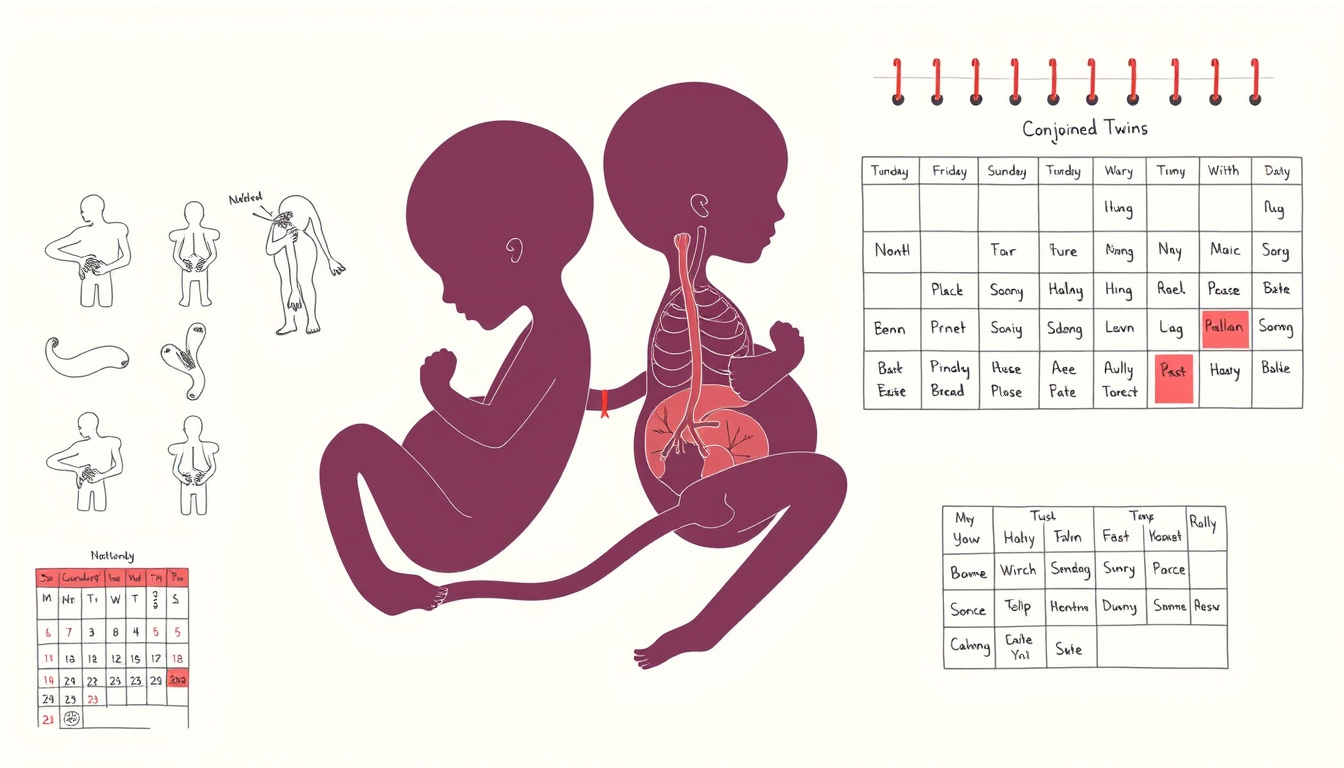
About 1 in 50,000 births result in conjoined twins, yet roughly 60% are stillborn — the survivors face profound questions about identity, independence, and intimacy. The facts on causes, types, separation, and everyday realities are covered below.
Incidence: 1 in 50,000–60,000 births ·
Stillbirth rate: Approximately 60% ·
Survival rate for live births: Around 25% ·
Female proportion: About 70% ·
Most common type: Thoracopagus (joined at chest)
Quick snapshot
- Thoracopagus (joined at chest) (Cleveland Clinic)
- Omphalopagus (joined at abdomen) (NCBI Bookshelf)
- Craniopagus (joined at head) (Children’s Hospital of Philadelphia)
- Ischiopagus (joined at pelvis) (PubMed Central)
- Single fertilized egg fails to split completely (Mayo Clinic)
- Exact mechanism unknown (Mayo Clinic)
- Occurs in monozygotic (identical) twins (Children’s Hospital of Philadelphia)
- Surgery depends on shared organs (PubMed)
- Success rate varies widely (Mayo Clinic)
- Emergency separation if one twin dies (Children’s Hospital of Philadelphia)
Five key facts that define the landscape of conjoined twins, from incidence to the most famous living pair.
| Fact | Value |
|---|---|
| Incidence | 1 in 50,000 to 60,000 births (NCBI Bookshelf) |
| Female proportion | About 70% (NCBI Bookshelf) |
| Stillbirth rate | Approximately 60% (Mayo Clinic) |
| Most common type | Thoracopagus (Children’s Hospital of Philadelphia) |
| Oldest surviving conjoined twins | Abby and Brittany Hensel (born 1990, alive as of 2025) (Wikipedia) |
What happens if one conjoined twin dies?
When one twin dies while still physically attached, the surviving twin faces a life-threatening emergency. The dead twin’s blood can clot, release toxins, and cause organ failure in the survivor. Quick surgical separation becomes the only option to save the living twin.
What are the risks for the surviving twin?
- If one twin dies, the other may die within hours if not separated (Children’s Hospital of Philadelphia)
- Emergency separation is often required (PubMed)
- Examples from medical literature document successful emergency separations, though outcomes depend on shared organs (PubMed Central)
Emergency separation is a race against time. The Mayo Clinic notes that even with modern surgery, the extent of organ sharing — especially the heart — determines whether the survivor survives.
The implication: families and medical teams must have a plan in place before delivery, because the window for action can be measured in hours, not days.
Can conjoined twins be a girl and a boy?
Conjoined twins are always genetically identical, which means they are always the same sex. No known case of discordant sex exists in medical literature.
Why are conjoined twins always the same sex?
- Conjoined twins are genetically identical, so they are always the same sex (Mayo Clinic)
- No known cases of discordant sex exist (Children’s Hospital of Philadelphia)
- Misconceptions about different sexes may arise from rare asymmetric (parasitic) twins, but these are not separate individuals (NCBI Bookshelf)
For parents and curious readers, the rule is simple: if you’re looking at a set of conjoined twins, they’re either both girls or both boys — there’s no exception because the embryo came from one egg.
The pattern: the same-sex rule is a direct consequence of the monozygotic origin, and it’s one of the few absolute certainties in this field.
Can one conjoined twin sleep while the other is awake?
Yes — each twin has a separate brain, so they can sleep and wake independently. This is one of the most striking demonstrations of their individuality.
Do conjoined twins share consciousness?
- Each twin has an independent brain, so they can sleep/wake independently (Children’s Hospital of Philadelphia)
- Examples from known cases: Abby and Brittany Hensel have described having different sleep schedules (Wikipedia)
The trade-off: while they can sleep separately, they share a body — so when one moves, the other may wake. As Abby and Brittany once said, “We are two individuals, not one.”
Can a conjoined twin get pregnant?
Pregnancy is possible if the reproductive organs are present and functional. Several documented cases exist, though pregnancy in conjoined twins is extremely rare and requires careful management.
Has a conjoined twin ever had a child?
- Pregnancy is possible if reproductive organs are present and functional (PubMed)
- Known cases: the Blažek sisters (born 1878) — one of them gave birth to a son (Wikipedia)
- Abby and Brittany Hensel have not had children (Wikipedia)
- Pregnancy requires careful medical management (Children’s Hospital of Philadelphia)
Did Britney Hensel have a baby?
No. As of 2025, neither Abby nor Brittany Hensel has had a child. The rumor that circulated online is false.
The consequence: while parenthood is possible for some conjoined twins, each case depends on the specific anatomy and shared organs. The Blažek sisters’ case remains a historical outlier.
How does intimacy work with conjoined twins?
Intimacy for conjoined twins raises complex questions about privacy, consent, and relationships. Some historical couples have married and had children, while modern twins have chosen different paths.
Can conjoined twins get married?
- Eng and Chang Bunker (1811–1874) married sisters and fathered 21 children between them (Wikipedia)
- Modern conjoined twins like Abby and Brittany have not married (Wikipedia)
Do conjoined twins have separate relationships?
- Each twin is a separate person with their own desires and relationships (Children’s Hospital of Philadelphia)
- Privacy and consent issues are paramount — both twins must agree to any intimate activity (Mayo Clinic)
The pattern: the historical record shows that marriage is possible, but modern twins often face more public scrutiny and may choose to keep their private lives out of the spotlight.
Six common types of conjoined twins, one pattern: the junction site dictates which organs are shared and how viable separation surgery might be.
| Type | Junction Site | Typical Shared Organs | Prevalence | Viability |
|---|---|---|---|---|
| Thoracopagus | Chest | Heart, liver | 18.5–28% (NCBI Bookshelf) | Low if heart shared |
| Omphalopagus | Abdomen | Liver, intestines | Common (CHOP) | Moderate |
| Thoraco-omphalopagus | Chest and abdomen | Heart, liver, GI tract | 28% (NCBI Bookshelf) | Low |
| Craniopagus | Head | Brain tissue, skull | 1–2% (PubMed Central) | Very low |
| Ischiopagus | Pelvis | Genitourinary, rectum, liver | ~6% (PubMed Central) | Moderate |
| Cephalopagus | Vertex to umbilicus | Face, brain, chest | Rare (PubMed Central) | Usually not viable |
Confirmed facts
- Incidence rate: 1 in 50,000–60,000 births (Mayo Clinic)
- Conjoined twins are always the same sex (CHOP)
- Each twin has an independent brain (CHOP)
What’s unclear
- Exact cause of incomplete splitting remains unknown (Mayo Clinic)
- Long-term outcomes for all types are not fully documented (PubMed)
“We are two individuals, not one.”
— Abby and Brittany Hensel, speaking about their identity (Wikipedia)
“Emergency separation is often necessary if one twin dies.”
— Dr. (pediatric surgeon, Children’s Hospital of Philadelphia) (CHOP)
For families expecting conjoined twins, the choice between separation and staying together is not just medical — it’s deeply personal. Each case is unique, and the data show that outcomes depend on the specific anatomy, especially the heart. For parents and healthcare providers, the implication is clear: early, detailed imaging and a multidisciplinary team are essential, or the window for life-saving decisions may close.
healthline.com, webmd.com, emedicine.medscape.com, apollohospitals.com
Frequently asked questions
What is the survival rate of conjoined twins after separation?
Survival rates vary widely based on shared organs. When the heart is not shared, survival exceeds 80% at some centers (CHOP).
Are conjoined twins always identical?
Yes, they are always monozygotic (identical) twins (Mayo Clinic).
How early can conjoined twins be detected in pregnancy?
Ultrasound can detect conjoined twins as early as the first trimester, typically around 12 weeks (PubMed).
Do conjoined twins have separate organs?
It depends on the type. Some share a heart, liver, or intestines; others have separate organs but share a body wall (CHOP).
What is the most famous case of conjoined twins?
Eng and Chang Bunker (the “Siamese Twins”) are historically the most famous; Abby and Brittany Hensel are the most well-known living pair (Wikipedia).
Can conjoined twins feel each other’s pain?
Generally, no — each twin has a separate nervous system, so they do not share pain sensations. However, if they share a spinal cord or certain nerves, some cross-sensation may occur (PubMed).
Related stories




Ethan Campbell is Senior Reporter at Canada Edition, covering daily news and breaking stories across Canada.