
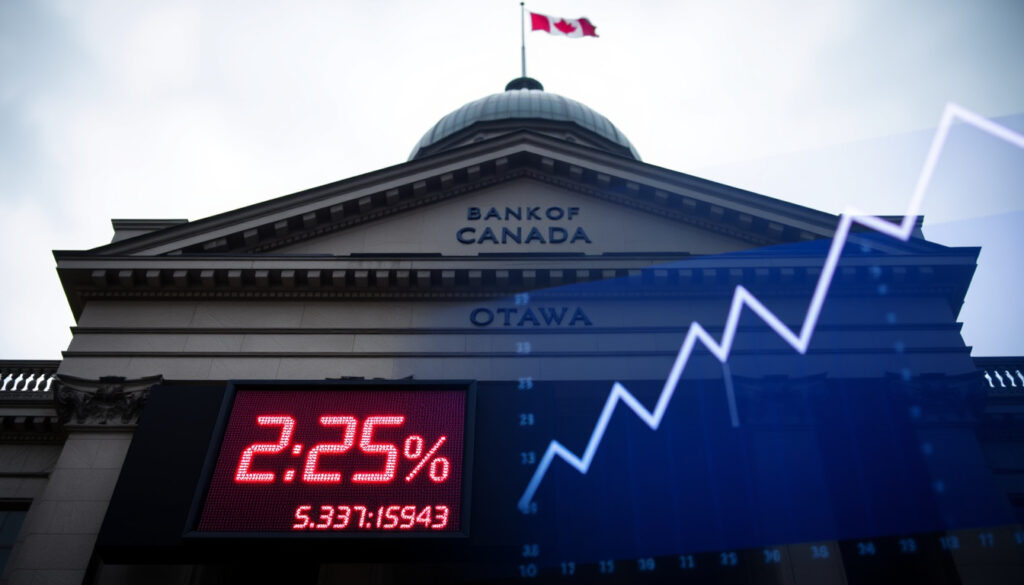
If you’ve been watching your mortgage renewal date creep closer while the Bank of Canada keeps rates on hold, you’re not alone in wondering what comes next. The central bank held its overnight rate at 2.25% in April 2026, citing U.S. trade policy as a continuing source of uncertainty.
Current target overnight rate: 2.25% ·
Last rate decision: April 2026 – held steady ·
Next scheduled announcement: One of eight fixed dates per year
Quick snapshot
- Overnight rate is 2.25% as of April 2026 (Bank of Canada – policy interest rate page)
- Bank holds eight fixed decision dates per year (Bank of Canada)
- Rate changes affect prime rates and variable mortgages directly (Bank of Canada – policy interest rate page)
- Exact timing of future rate cuts remains uncertain
- Whether rates will return to 3% is unknown
- Impact of U.S. trade policy on Canadian rate path is unclear
- April 2026: Bank holds rate at 2.25% (Bank of Canada press release)
- 2025: Series of cuts brought rate from 5% to 2.25% (Bank of Canada press release)
- 2022–2023: Aggressive hikes from 0.25% to 5% (Bank of Canada press release)
- Next decision: June 10, 2026 (Bank of Canada)
- Next Monetary Policy Report: July 15, 2026 (Bank of Canada)
- Market pricing implies several rate cuts over two years (Bank of Canada)
| Current target overnight rate | 2.25% |
|---|---|
| Bank of Canada policy rate | 2.25% (target for overnight) |
| Last decision | April 2026 – held |
| Next scheduled announcement | One of eight fixed dates per year |
The table above shows the rate hold is more than a pause — it is a signal that trade uncertainty now trumps inflation concerns in the Bank’s decision-making.
What is the Bank of Canada’s interest rate today?
Current overnight rate
The Bank of Canada’s target for the overnight rate is 2.25%, confirmed on April 29, 2026, with the Bank Rate at 2.5% and the deposit rate at 2.20%, according to the Bank of Canada’s official press release (central bank). This rate has been held since October 2025 after a series of cuts from 5%.
How this rate is set
The overnight rate is the Bank’s main policy instrument, set by the Governing Council on eight fixed dates each year. Governor Tiff Macklem stated in the April 2026 press conference that the council reached a clear consensus to maintain the policy interest rate where it is, as reported by the Bank of Canada press conference video (central bank).
The implication: the hold signals that the Bank sees no clear reason to cut yet, but also no urgent need to raise — a wait-and-see posture driven by trade risks.
What date is the next interest rate decision?
Scheduled decision dates in 2026
The Bank of Canada announces its overnight rate target on eight fixed dates each year. The next scheduled date after April 29, 2026, is June 10, 2026, and the next Monetary Policy Report is set for July 15, 2026, as confirmed by the Bank of Canada’s press release (central bank). Decisions are announced at 10 a.m. ET on scheduled days.
How to stay updated
You can find the full calendar and all historical rate decisions on the Bank of Canada’s policy interest rate page (central bank). The page shows rates held at 2.25% on March 18, 2026, and January 28, 2026, indicating consecutive holds in 2026.
The exact next date — June 10 — is the single most important marker for anyone with a variable-rate mortgage or a renewal in the second half of 2026.
The pattern: fixed dates give borrowers predictability, but the gap between decisions means market expectations can shift sharply in between.
Why is the Bank of Canada holding its interest rate again?
Reasons behind the hold
The Bank held the rate at 2.25% in April 2026 because U.S. trade policy continues to reshape global trade patterns and remains an ongoing source of uncertainty, the Bank said in its press release (central bank). Governor Macklem added there is no risk-free path for the policy interest rate, as noted in the Bank of Canada press conference video (central bank).
Economic context
The Bank projected Canadian GDP growth of 1.2% in 2026, 1.6% in 2027, and 1.7% in 2028. Consumer and government spending were supporting activity, while tariffs and trade uncertainty weighed on exports and business investment. The Bank’s April 2026 outlook assumes tariffs remain unchanged, according to the Bank of Canada press release (central bank).
The catch: the hold protects against further inflation surprises but delays relief for households expecting lower variable rates.
Will interest rates drop to 3% again?
Analyst expectations
Some forecasts suggest rates could decline toward 3% by 2027, but the Bank of Canada has not committed to any specific path. Market pricing implies several rate cuts over the next two years. However, the Bank’s policy outlook depends importantly on the Canada-US-Mexico trade agreement, the conflict in the Middle East, US tariffs, and energy prices, as the Bank of Canada press release (central bank) states.
Historical perspective
From 2022 to 2023, the Bank raised rates aggressively from 0.25% to 5% to combat inflation. By 2025, a series of cuts brought the rate from 5% to 2.25%, as shown in the Bank of Canada’s policy interest rate history (central bank). The rate history shows consecutive holds in 2026 at 2.25%.
For borrowers, a path back to 3% would mean significant payment relief. For savers, it would reduce returns on savings accounts and GICs. The Bank’s data-dependent stance means no one gets a guarantee.
The pattern: the Bank prefers to act only when data clarifies direction — and right now trade uncertainty keeps the data murky.
Should I get a 3 or 5 year fixed mortgage?
Rate differences
3-year fixed mortgage rates are typically lower than 5-year rates because lenders price in less term risk. A shorter term gives you the chance to refinance at potentially lower rates sooner, while a longer term locks in predictable payments for five years.
Term length trade-offs
According to Copperfin Credit Union (financial institution), the choice depends on your financial goals and risk tolerance. If you believe rates will fall further, a 3-year fixed gives you flexibility to renegotiate earlier. If stability matters more, a 5-year fixed protects against potential rate increases.
- 3-year fixed: Lower rate, earlier renewal chance, good for those betting on further cuts
- 5-year fixed: Higher rate, longer payment stability, protects against unexpected hikes
The implication: your term choice is effectively a bet on where the Bank’s rate path goes by 2027 or 2029.
Confirmed facts
- Current overnight rate is 2.25% (Bank of Canada)
- Bank of Canada meets eight times a year (Bank of Canada)
- Rate decisions affect prime rates and variable mortgages
- Next decision is June 10, 2026 (Bank of Canada)
What’s unclear
- Exact timing of future rate cuts
- Whether rates will return to 3%
- Impact of U.S. trade policy on Canadian rates
“There is no risk-free path for the policy interest rate.”
— Tiff Macklem, Governor, Bank of Canada press conference (central bank), April 29, 2026
“Tariff threats were a major reason for the hold, as trade uncertainty continues to weigh on business investment and exports.”
— TD Economics, reported via TD Stories (major Canadian bank)
For Canadian homeowners, the choice remains: lock in stability now with a fixed term, or bet on cuts by 2027 with a shorter-term or variable mortgage.
Frequently asked questions
What is the Bank of Canada’s overnight rate?
The overnight rate is the interest rate at which major financial institutions borrow and lend one-day (overnight) funds among themselves. The Bank of Canada sets a target for this rate, which influences other interest rates like prime rates and variable mortgage rates. As of April 2026, the target is 2.25%.
How often does the Bank of Canada change interest rates?
The Bank of Canada adjusts the target for the overnight rate on eight fixed dates each year. Decisions are announced at 10 a.m. ET on those days. The Bank may also make unscheduled changes in exceptional circumstances.
What is the prime rate, and how does it relate to the Bank of Canada rate?
The prime rate is the interest rate that commercial banks charge their most creditworthy customers. It closely follows the Bank of Canada’s overnight rate — when the Bank changes its rate, banks typically adjust their prime rate by the same amount.
How do Bank of Canada rate changes affect mortgage payments?
Variable-rate mortgages are directly tied to the prime rate, so a change in the Bank of Canada’s overnight rate leads to a change in your monthly payment. Fixed-rate mortgages are influenced by bond yields, which react to rate expectations, but the impact is less direct and immediate.
When will the Bank of Canada next cut rates?
The Bank has not committed to any specific timing for future cuts. The next scheduled decision is June 10, 2026. Future moves depend on economic data, particularly inflation, trade policy, and GDP growth.
What is the difference between the Bank of Canada rate and the federal funds rate?
The Bank of Canada rate is Canada’s key policy rate, set by the Bank of Canada. The federal funds rate is the equivalent policy rate set by the U.S. Federal Reserve. While they often move together, they can diverge based on each country’s economic conditions.
Why does the Bank of Canada raise or lower rates?
The Bank adjusts rates to keep inflation at its 2% target. Raising rates slows economic activity and reduces inflation; lowering rates stimulates borrowing and spending. The Bank also considers employment, GDP growth, and global risks like trade policy.
Related stories





Nathan Brooks covers federal and provincial politics and public policy for Canada Edition.