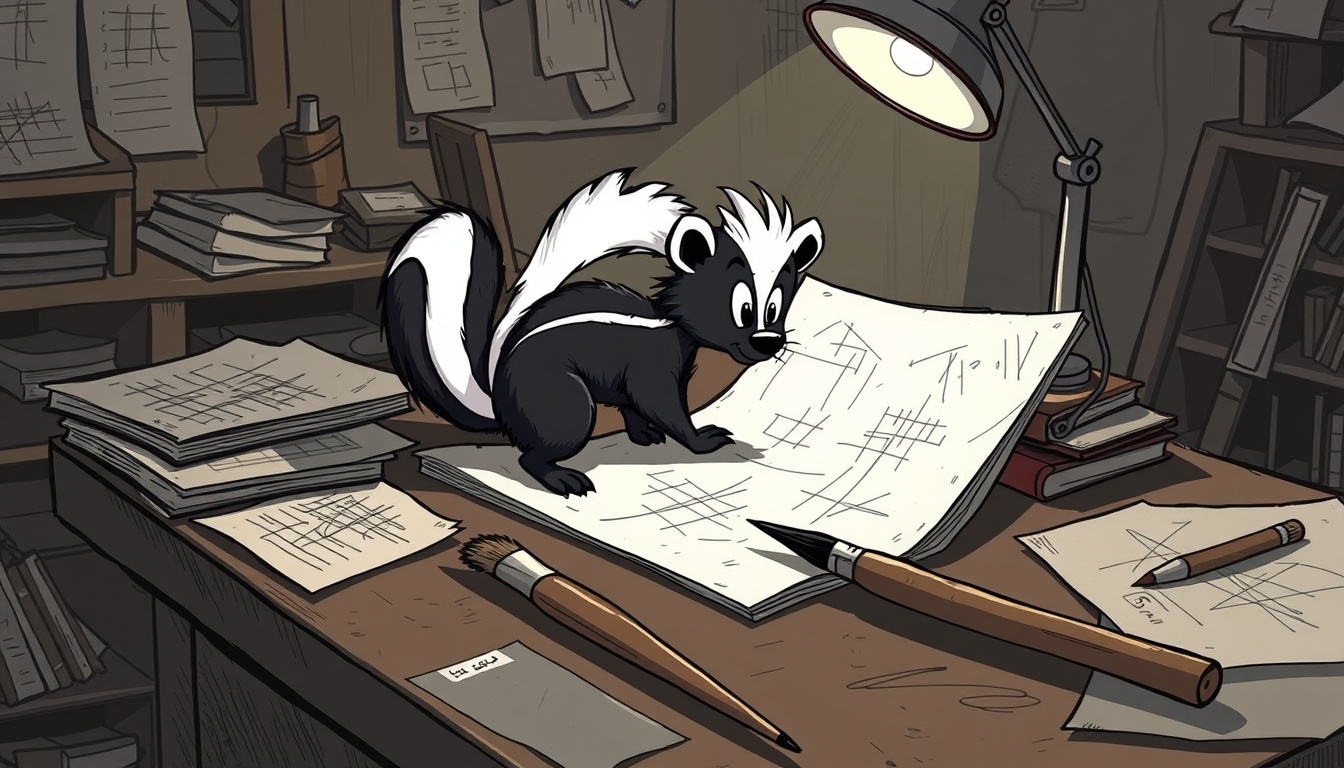
The skunk who spoke with a French accent and chased a cat through every cartoon was intended to be a harmless gag. But over the decades, Pepé Le Pew became something his creator never planned: a flashpoint in debates about consent, comedy, and cancel culture.
First appearance: 1945 ·
Creator: Chuck Jones ·
Academy Award win: 1949 (For Scent-imental Reasons) ·
Last original Looney Tunes short: 1962 ·
Current status: Retired from Warner Bros. in 2021 ·
Primary target in controversy: Non-consensual pursuit narrative
Quick snapshot
- Pepé Le Pew debuted in 1945 (Wikipedia encyclopedia entry on Pepé Le Pew)
- Warner Bros. removed him from upcoming projects in 2021 (Snopes fact-checking report on Pepé Le Pew)
- Short ‘For Scent-imental Reasons’ won an Oscar in 1949 (Wikipedia encyclopedia entry on Pepé Le Pew)
- Whether the character is permanently banned from all Warner Bros. media is not confirmed
- The ‘banned for 44 years’ narrative is a myth; he aired on TV for most of that period
- Exact future of the character remains unspecified by Warner Bros.
- Whether the removal was a direct response to the op-ed or a pre-existing decision remains debated
- 1945: First appearance in ‘Odor-able Kitty’
- 1949: Oscar win for ‘For Scent-imental Reasons’
- March 2021: Warner Bros. retires Pepé from future projects
- Classic Pepé shorts remain available on streaming and TV
- No indication of new content featuring the character
- Debate over comedy norms and consent continues in media
Eight key facts about the character, from his name to his retirement:
| Label | Value |
|---|---|
| Full name | Pepé Le Pew |
| Species | Anthropomorphic skunk |
| Creator | Chuck Jones |
| First short | Odor-able Kitty (1945) |
| Oscar-winning short | For Scent-imental Reasons (1949) |
| Love interest | Penelope Pussycat |
| Catchphrase | “My leetle cabbage” or “Mon cheri” |
| Retirement date | March 2021 |
Why was Pepé Le Pew canceled?
The 2021 decision by Warner Bros.
In March 2021, Warner Bros. confirmed that Pepé Le Pew would not appear in Space Jam: A New Legacy or any other upcoming projects. The studio’s statement did not describe a permanent ban, but the practical effect was clear: the character was retired from active use. Snopes fact-checking report on Pepé Le Pew reported that the scene had actually been cut before the public controversy, under director Malcolm D. Lee after Terence Nance left the film. The timing created the impression that the removal was a direct response to a single op-ed, but the studio’s decision preceded the public outcry.
Warner Bros. cut the Pepé Le Pew scene from Space Jam 2 before Charles M. Blow’s column ran, meaning the studio’s move was not a knee-jerk reaction but a gradual shift in editorial standards.
The New York Times op-ed that reignited debate
On March 6, 2021, The New York Times published an op-ed by Charles M. Blow titled “The End of the Cartoon Rape Culture.” Blow argued that Pepé Le Pew’s behavior normalized non-consensual pursuit and called the character “a cartoon rapist.” The column was widely shared and quickly became a flashpoint. The Guardian UK news publication later framed the episode as part of a larger history of cancel-culture debates in animation.
Comparison with other character retirements
Pepé Le Pew is not alone. Speedy Gonzales was removed from many Looney Tunes compilations in the 2000s over ethnic stereotyping, and several Dr. Seuss titles were pulled in 2021 for racist imagery. MovieWeb entertainment news site grouped Pepé with these cases, noting that the character’s retirement is part of a broader reassessment of old cartoons. The implication: what was once considered harmless may become unacceptable as cultural norms evolve.
What is the real story behind Pepé Le Pew?
Origins and creation by Chuck Jones
Pepé Le Pew first appeared in the 1945 short Odor-able Kitty, directed by Chuck Jones. The character was a skunk who falls in love with a black cat that has been painted with a white stripe, mistaking her for a fellow skunk. Wikipedia encyclopedia entry on Pepé Le Pew notes that the gag relied on the visual joke of mistaken identity and the cat’s frantic attempts to escape.
The gag of mistaken identity (painted cat)
Penelope Pussycat, the love interest, was never a real skunk. She was a black cat who accidentally got a white stripe of paint on her back. The chase dynamic was one-sided: Pepé interpreted her panicked flight as romantic play, while she desperately tried to escape. This was the core comic premise for nearly two decades of shorts.
The characterization as a romantic but oblivious skunk
Pepé spoke with a thick French accent, called Penelope “my leetle cabbage,” and seemed genuinely unaware that his affections were unwelcome. Wikipedia encyclopedia entry on Pepé Le Pew describes him as “the embodiment of the persistent, overly amorous French stereotype.” Critics later argued that this obliviousness is precisely what makes the character problematic — his refusal to take no for an answer was played for laughs.
What is the meaning of Pepé Le Pew?
Translation of the name into English
The name “Pepé” is a French nickname for Joseph, and “Le Pew” is a pun on le putois, French for “the skunk.” So the full name translates roughly to “Joseph the Skunk.” The character’s accent and catchphrases further reinforced the Gallic caricature.
Character as a stereotype of French romance
Pepé Le Pew epitomized the American stereotype of the French as irrepressible romantics who never take rejection seriously. Wikipedia encyclopedia entry on Pepé Le Pew states that the character was “a parody of the French lover,” and his behavior was meant to be exaggerated for comedic effect. The problem, as the British Film Institute film archive and cultural institution noted, is that the joke only works if the audience agrees that the target’s discomfort is funny.
The skunk’s spray as a metaphor
Pepé’s skunk spray, which he uses to incapacitate others, can be read as a metaphor for unwanted sexual advances. The intersection of physical force (the spray) and emotional coercion (the relentless pursuit) is what critics point to when they argue the character normalizes harassment.
Why is Pepe Le Pew offensive?
Non-consensual pursuit narrative
The central criticism of Pepé Le Pew is that his behavior mirrors real-world stalking and sexual harassment. In every short, Penelope Pussycat tries to flee, and Pepé ignores her protests, interprets her fear as flirting, and continues his pursuit. KUTV local CBS affiliate reported that the character was accused of “normalizing rape culture.”
The ‘chase’ dynamic with Penelope Pussycat
Penelope’s body language is always that of a terrified animal trying to escape. She never consents, and her voice (when she has one) is a scream. The humor relies on the audience finding her distress amusing. The Independent UK news outlet noted that the character became a symbol in broader debates about consent in media.
Impact on cultural conversations about consent
The controversy around Pepé Le Pew contributed to a larger shift in how audiences and studios view consent in comedy. The Guardian UK news publication argued that the debate is not about censorship but about whether outdated norms should continue to be distributed to children without context.
How did Pepe Le Pew become a character in the culture war?
The 2021 New York Times op-ed by Charles M. Blow
Blow’s column was the match that lit the fire. He wrote that Pepé Le Pew “normalizes stalking and sexual assault,” and called for the character’s retirement. The op-ed went viral, drawing both praise and condemnation. The Independent UK news outlet reported that Fox News and other conservative outlets seized on the story as an example of cancel culture run amok.
Social media backlash and support
Twitter and Reddit exploded with arguments. Some users posted Pepé Le Pew GIFs as a form of protest, embracing the character as a symbol of anti-cancel-culture sentiment. Others shared clips of the cartoons to highlight the uncomfortable subtext. The divide was stark and predictable along political lines.
Warner Bros. response and retirement
Warner Bros. did not formally ban the character, but quietly removed him from the Space Jam sequel and did not include him in the 2021 Looney Tunes Cartoons streaming series. Snopes fact-checking report on Pepé Le Pew confirmed that the scene was cut before the op-ed ran, but the public perception — that the character was “canceled” — stuck. The studio’s non-committal statement left room for interpretation, fueling the culture-war narrative.
What cartoon was banned for 44 years?
The ‘Censored Eleven’ and other banned Looney Tunes
The “Censored Eleven” are a group of Looney Tunes shorts that were pulled from television syndication in 1968 because of racial stereotypes. These cartoons, featuring characters like Speedy Gonzales and the Bosko series, were kept out of circulation for decades. Pepé Le Pew was never part of that list.
Distinction from Pepé’s retirement
Some online sources have claimed that Pepé Le Pew was “banned for 44 years.” That is false. His shorts continued to air on TV and streaming services until 2021. The confusion likely stems from conflating the Censored Eleven with the 2021 decision. Wikipedia encyclopedia entry on Pepé Le Pew clarifies that the character was not banned; he was simply not included in future productions.
Misinformation and the ‘banned’ myth
The “banned for 44 years” myth spread rapidly on social media, often used as evidence of cancel-culture excess. In reality, Pepé Le Pew appeared in new media as recently as 2003’s Looney Tunes: Back in Action and was a staple of Cartoon Network’s reruns for decades. The myth persists because it fits a convenient narrative, but the facts do not support it.
The claim that Pepé Le Pew was “banned for 44 years” is a textbook example of how misinformation amplifies culture-war polarization. The actual timeline shows a character who was in continuous use, not a long-suppressed artifact.
The pattern is clear: a simple factual correction — the character was retired, not banned — gets lost in the noise of competing narratives.
Timeline
- 1945 — Pepé Le Pew first appears in Odor-able Kitty as a skunk pursuing a cat painted with a white stripe. (Wikipedia encyclopedia entry on Pepé Le Pew)
- 1949 — For Scent-imental Reasons wins Academy Award for Best Animated Short. (Wikipedia encyclopedia entry on Pepé Le Pew)
- 1962 — Last original Looney Tunes short featuring Pepé, Louvre Come Back to Me! (Wikipedia encyclopedia entry on Pepé Le Pew)
- 2003 — Pepé appears in Looney Tunes: Back in Action. (Wikipedia encyclopedia entry on Pepé Le Pew)
- March 2021 — Warner Bros. retires Pepé from future projects following a New York Times op-ed. (Snopes fact-checking report on Pepé Le Pew)
- 2022 — Pepé is not included in Space Jam: A New Legacy or Looney Tunes Cartoons. (Snopes fact-checking report on Pepé Le Pew)
Clarity check
Confirmed facts
- Pepé Le Pew debuted in 1945. (Wikipedia encyclopedia entry on Pepé Le Pew)
- Warner Bros. removed him from upcoming projects in 2021. (Snopes fact-checking report on Pepé Le Pew)
- The character’s behavior involves non-consensual pursuit of Penelope Pussycat. (KUTV local CBS affiliate)
- The short For Scent-imental Reasons won an Oscar. (Wikipedia encyclopedia entry on Pepé Le Pew)
What’s unclear
- Indefinite permanent ban from all Warner Bros. media is not confirmed.
- Whether the character was ‘banned for 44 years’ is a myth; he aired on TV for most of that period.
- The exact future of the character remains unspecified by Warner Bros.
- Whether the removal was a direct response to the op-ed or a pre-existing decision remains debated.
Quotes
“Pepé Le Pew is a cartoon rapist.”
— Charles M. Blow, New York Times op-ed, 2021
“The removal of Pepé Le Pew from the film was part of a broader discussion about censorship and cartoon controversy.”
— British Film Institute
“The debate is part of a larger history of ‘cancel culture’ in cartoons.”
— The Guardian, 2021
For Warner Bros., the choice to retire Pepé Le Pew was not a ban but a business decision. The character that once symbolized innocent cartoon fun became a liability in an era where consent is taken seriously. The real consequence is not that Pepé is gone, but that the conversation around comedy norms has permanently shifted — and that shift leaves no room for the old “it’s just a joke” defense.
Related reading: **Daffy Duck: Species, Catchphrases, Cartoons, and More** · **Brie Larson: Controversies, Husband, Career & Updates (2024)**
looneytunes.fandom.com, reddit.com, movieweb.com, youtube.com, youtube.com, pt.wikipedia.org
Frequently asked questions
What does Pepé Le Pew mean in English?
The name translates roughly to “Joseph the Skunk.” “Pepé” is a French nickname for Joseph, and “Le Pew” is a pun on le putois, French for “the skunk.”
Is Pepé Le Pew banned from all Warner Bros. media?
No. Warner Bros. has not issued a permanent ban. The character was simply not included in new projects after 2021. Classic shorts remain available on streaming and TV.
What was the name of Pepé Le Pew’s girlfriend?
Penelope Pussycat. She was a black cat who was painted with a white stripe, leading Pepé to mistake her for a skunk.
Did Pepé Le Pew actually win an Oscar?
Yes, the short For Scent-imental Reasons (1949) won the Academy Award for Best Animated Short.
Why do some people find Pepé Le Pew funny?
Fans argue the humor is based on the absurdity of the situation — a skunk who is oblivious to rejection. Critics counter that the humor relies on normalizing non-consensual pursuit.
Are there other Looney Tunes characters retired for similar reasons?
Yes, Speedy Gonzales was removed from compilations over ethnic stereotyping, and several Dr. Seuss titles were pulled for racist imagery. Pepé’s case is part of a broader pattern.
When did Pepé Le Pew first appear?
He first appeared in the 1945 short Odor-able Kitty.
Related stories




Ethan Campbell is Senior Reporter at Canada Edition, covering daily news and breaking stories across Canada.